

Ear to the ground: listening to grain producers talk about sustainable practices
When discussing sustainable agriculture, the conversation often quickly shifts toward principles, climate targets, or broad policy directions. But on the ground, the real question is: does it work here, on my farm, with my soils, my equipment, my contracts, and my margins?
With this premise in mind, in the summer of 2025 we conducted a series of phone interviews with 18 conventional grain producers who have progressed in adopting sustainable practices, mainly in the Montérégie region. These farms varied widely in size, from 55 to more than 1,500 hectares, yet all face the same daily trade-offs between yield, risk management, soil health, and economic viability. This work is part of the project Return on investment of the agroenvironmental transition in field crops, led by FoodBridge in collaboration with Groupe ProConseil, with support from the Government of Quebec.
What emerges from these conversations is far from ideological. Instead, we hear about a pragmatic agricultural transition, where decisions are based on repeated observations, trials, occasional setbacks, and a very concrete cost–benefit analysis.
When sustainability aligns with agronomic logic
Practices that endure over time are not those driven by trends, but those that address a tangible problem. No-till and reduced tillage are notable examples. Several producers gradually adopted these approaches to reduce field passes, lower fuel costs, and limit compaction, while observing improvements in soil structure and water infiltration. That said, this is not a uniform or complete conversion. Some still combine no-till with targeted shallow tillage, particularly on heavy soils, to ensure more even crop emergence.
Cover crops also occupy a central place in the strategies described. Multi-species mixes, winter-killed or winter-hardy species: choices vary, but the motivation stays the same. Keeping living roots in the soil longer, protecting against erosion, improving organic matter, and supporting biological activity. Once again, decisions are not based on abstract discourse, but on repeated seasonal observations.
Crop diversification, often three or more crops among respondents, appears as another advantageous practice. Integrating winter cereals, rye, barley, legumes, or forage crops not only spreads agronomic risk but also creates planting windows for cover crops and helps distribute workload more evenly. In a more variable climate context, diversification is perceived as a tool to improve both agronomic and economic stability.
What consistently emerges is that practices are maintained when they deliver observable benefits on the farm. Sustainability here is not the goal in itself; it becomes relevant when it strengthens operational or economic resilience.
Transition: rarely a linear path
Producers rarely describe adoption as simple or immediate. Rather, they speak of trials on small plots, yield comparisons, equipment adjustments, and sometimes temporary returns to intermediate practices before a more structured re-adoption.
The challenges identified are very much field-level realities. On heavy clay soils, no-till can lead to uneven emergence and initial yield reductions. Interseeded cover crops may be limited by difficulties in achieving uniform establishment, sensitivity to timing, and the need for specialized machinery. Residue management can further complicate already tight planting windows. Adapting or replacing machinery represents a significant investment that must be justified.
Beyond technical constraints, there is also a subtler but equally real shift: accepting that a field may no longer match the traditional image of a perfectly worked, visually uniform soil. Several producers refer to a shift in perception, and to a learning process that requires time and a certain level of tolerance for uncertainty.
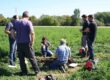
In this context, networks play a key role. Agri-environmental clubs, producer cohorts, farm visits, and peer exchanges help reduce decision-making isolation. Seeing a practice work on a neighboring farm under comparable conditions changes risk perception. This collective learning and connection-building approach lies at the heart of FoodBridge’s model: creating structured collaborations that transform individual experimentation into shared knowledge.
What facilitates adoption: reducing uncertainty
Three main drivers stand out:
- First, direct technical support. Soil analyses, biological indicators, and recommendations tailored to local realities help structure decision-making and secure trials.
- Second, financial assistance programs play a decisive role. The purchase of specialized equipment or the establishment of cover crops becomes more feasible when initial costs are shared.
- Finally, access to comparable economic data – margins per hectare, impacts on subsequent crops, regional performance – anchors decisions in a business logic. Without such data, adoption remains more fragile.
This directly aligns with our positioning: demonstrating that the transition toward sustainable and regenerative practices is not only an environmental response, but also a strategic driver for farm and supply chain resilience.
Abandonment does not mean giving up
Some practices are nevertheless set aside, often following trials deemed inconclusive in a given context. Attempts at no-till abandoned on very heavy soils due to inadequate equipment. Less profitable crops removed from rotations because of excessive yield variability.
The decisions described are based on precise agronomic, logistical, and economic constraints. Initial yield losses can, in some cases, exceed the cost of an additional mechanical pass. Application windows for organic fertilizers may be too narrow to ensure optimal management. Maintaining hedgerows may require more time and resources than anticipated.
These adjustments do not reflect disengagement. Rather, they illustrate careful risk management in businesses operating with tight margins and high market volatility.
Going further, gradually
When asked about the next three years, most producers expressed a willingness to deepen their practices, but along a progressive trajectory. Strengthening soil cover, integrating more winter cereals, refining nitrogen management, testing technologies such as connected weather stations or drone seeding – always through targeted trials before broader adoption.
What we take away from this project is simple, yet demanding: agricultural transition cannot be decreed. It must be built on the technical and economic realities of each farm.
The true return on investment is not measured solely in harvested tonnes or short-term cost savings. It is measured in a farm’s ability to navigate climate variability, maintain soil health, and secure market outlets in an increasingly uncertain environment.