

Let’s Raise a Glass to Biodiversity
By Clara Drolet-Lauzon, Nadine Bachand and Linsey Van Koppen
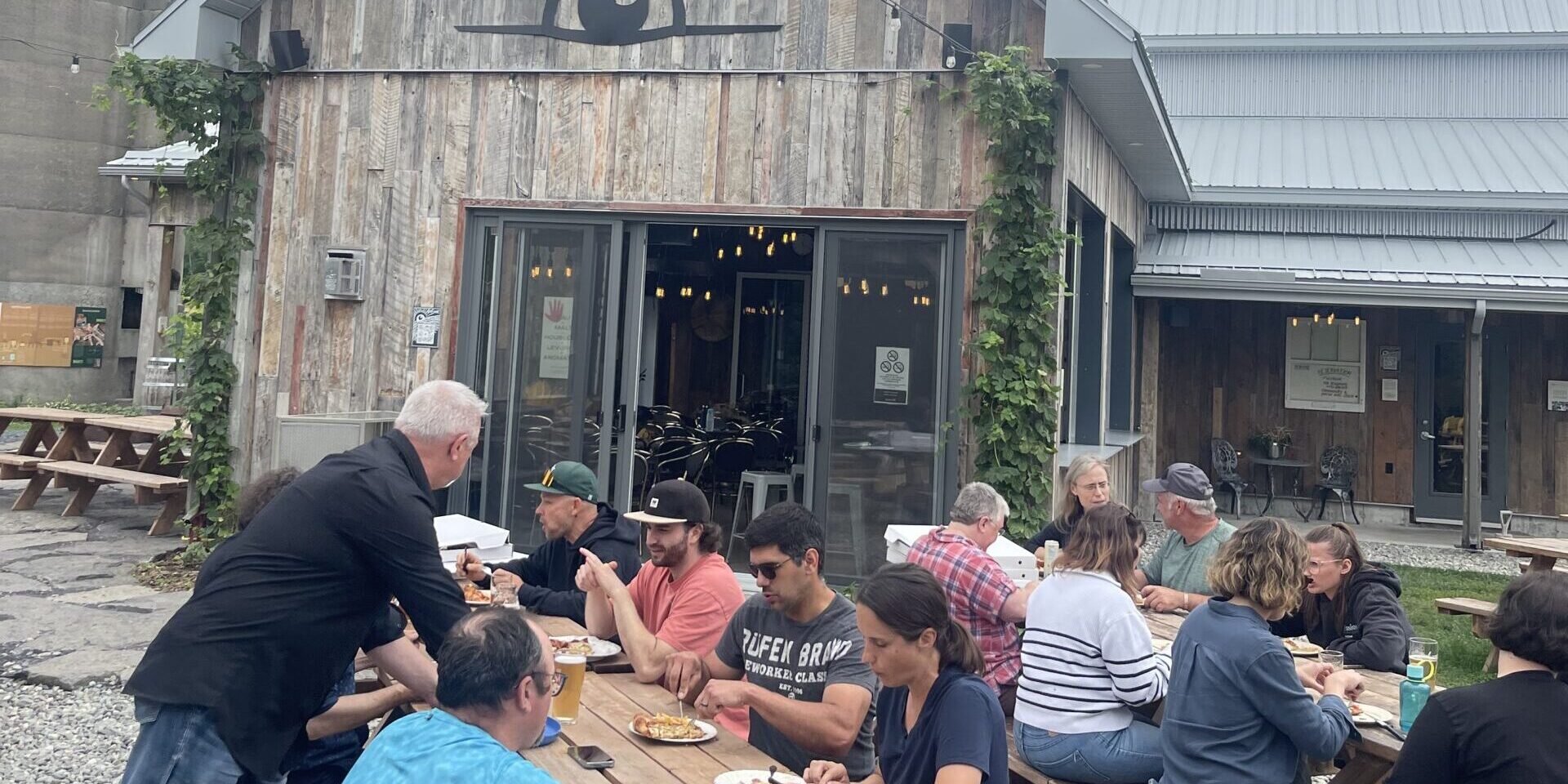
What if enjoying a beer could help support better farming practices in the field? A sunny patio, grasses swaying nearby, this is the kind of setting offered by farm breweries.
When we think of local beer, hops usually come to mind first. Yet the beer’s main ingredient is rarely the one we talk about most: barley. Adding it to field crop rotations dominated by corn and soybeans helps increase the diversity of crops grown across the landscape. Turning barley into malt is a craft mastered by malt houses: soaked, germinated in rotating drums, and then dried, during this final step, the grain develops the colors that distinguish a pale ale from a darker brew. In the case of farm breweries, the grain goes to the malt house and then returns, ready for brewing : the loop closes on-site, from soil to glass.
The Promise of Winter Barley
Despite increased interest in winter barley production in Ontario, growing malting barley to the required quality specifications remains a major challenge. In Quebec, members of our winter barley cohort, Terre à boire and La Ferme Brasserie Rurale are among the visionaries experimenting with this cereal crop. Planted in the fall and harvested in the summer, winter cereals offer the potential for double cropping and keeping living roots in the soil for most of the year. The result: increased production, less erosion, reduced runoff into waterways, and healthier, more fertile soils over the long term. The greater the diversity of crops above ground, the greater the diversity of microorganisms in the soil tends to be, fostering a richer and more resilient underground ecosystem. Growing winter barley is therefore a concrete way to support biodiversity in agricultural landscapes. Although early trials of winter barley have been promising, without altering malt flavor, more experimentation is still needed to confirm these results.
A Risky, Undervalued Crop
Contrary to what one might think, not all malting barley ends up in a pint glass. Barley remains a finicky crop, and obtaining malting grade, essential for malt houses to purchase it, depends on meeting precise criteria: appropriate protein levels, strong germination capacity, and optimal grain size, among others. A few untimely rain events, difficult harvesting conditions, or imperfect storage can be enough to compromise quality. When barley fails to meet the standards sought by maltsters or brewers, it is often redirected to animal feed, a much less profitable market for producers.
For farmers, the gamble is therefore a risky one. In addition to limited processing capacity in the province, this is one of the reasons why Ontario still struggles to build a robust malting barley sector, despite growing interest in local ingredients. While demand for local products appears to be gaining momentum, beer brewed here more often than not contains ingredients sourced from Western Canada. Beyond producing flavors rooted in their territory, farm breweries also embody short food supply chains. Agritourism centered on brewing thus becomes a tangible way to reconnect with what is happening in our fields.
This summer, visiting a farm brewery can be much more than a culinary outing. It is an opportunity to support rural businesses that invest in proximity, experimentation, and often, ingredients grown close to home.
To brighten your summer discoveries, terroir beers from farm breweries can be found across several regions in Ontario:
- GoodLot Farmstead Brewing Co – Caledon, Peel County
- Mackinnon Brothers Brewing Co – Bath, Lennox and Addington County
- Ramblin’ Road Brewery Farm – La Salette, Norfolk County
- Charlotteville Brewing Company – Simcoe, Norfolk County
- Meuse Brewing Company – Scotland, Brant County
- Badlands Brewing Company – Caledon, Peel County