

Partner Spotlight: Farinart – Family and entrepreneurial roots serving soil health
In Québec’s agri-food landscape, some companies play a discreet yet innovative role within our supply chains. Farinart is one of them.
A family-owned company specializing in grain processing, Farinart is now driven by a new generation. Élisabeth and Benjamin Brasseur are carrying the business forward with a strategic vision for sustainability: producing high-quality grain blends and specialty flours while paying close attention to how the grains are grown upstream.
Because behind every kilogram of processed grain, there are soils, crop rotations, agronomic decisions, and climate risks that directly influence supply.
Beyond ESG commitments
Like many agri-food companies, Farinart structures its ESG (Environmental, Social, and Governance) approach in part by accounting for its greenhouse gas emissions. But rather than limiting its environmental efforts to a GHG inventory, the company has chosen to act more directly upstream in its supply chain.
With FoodBridge, Farinart is currently developing the “Grains Vivants” program (Living Grains), an agroecology initiative designed to directly support grain producers in integrating regenerative practices, in collaboration with the Terralis consortium and Groupe ProConseil.
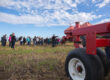
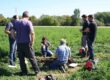
A first peer-learning cohort of about twenty producers from Montérégie and Centre-du-Québec is being supported by agronomists and the FoodBridge team. The objective is to implement practices that keep living roots in the soil for as long as possible throughout the year, particularly by optimizing cover crops and crop rotations.

A project rooted in an agricultural family history
Behind the Living Grains program are strong family values. Élisabeth brings a vision focused on innovation in response to evolving market expectations, while Benjamin represents the agricultural roots of the project, supported by his training in agricultural economics. The family also still owns farmland operated by their grandparents in Nominingue, in the Hautes-Laurentides region.
This direct connection to the land gives the initiative a particular meaning. Soil health is not an abstract concept; it is part of the family’s history.
By focusing on soil vitality as the foundation of grain quality, Farinart is positioning its growth within a long-term perspective. The “Grains Vivants” program (Living Grains) reflects this structured, collaborative, and measurable approach, one that begins in the fields before becoming ingredients for bakeries.
Measuring what matters
The practices implemented will be monitored and documented, while the costs of these practices and their environmental benefits (improved soil health, potential emissions reductions, and better nutrient management) will be assessed to better understand the links between efforts made in the field and agronomic and economic outcomes.
The goal is to obtain a realistic picture of the cost-effort-benefit balance for farm businesses, ensuring that the transition also relies on concrete and comparable data.
A first cohort aiming higher
The 2026-2027 cohort represents a first step. The intention is to gradually expand the model to other producers and regions by structuring a network of partner agronomists and mobilizing public and private funding to support the initiative.
For Farinart, this work helps secure a high-quality supply in a context where climatic and economic pressures are making value chains more vulnerable. For producers, it means being supported in adopting practices that strengthen the resilience of their soils while maintaining their economic viability.