
Bankers Take the Field
By Yourianne Plante
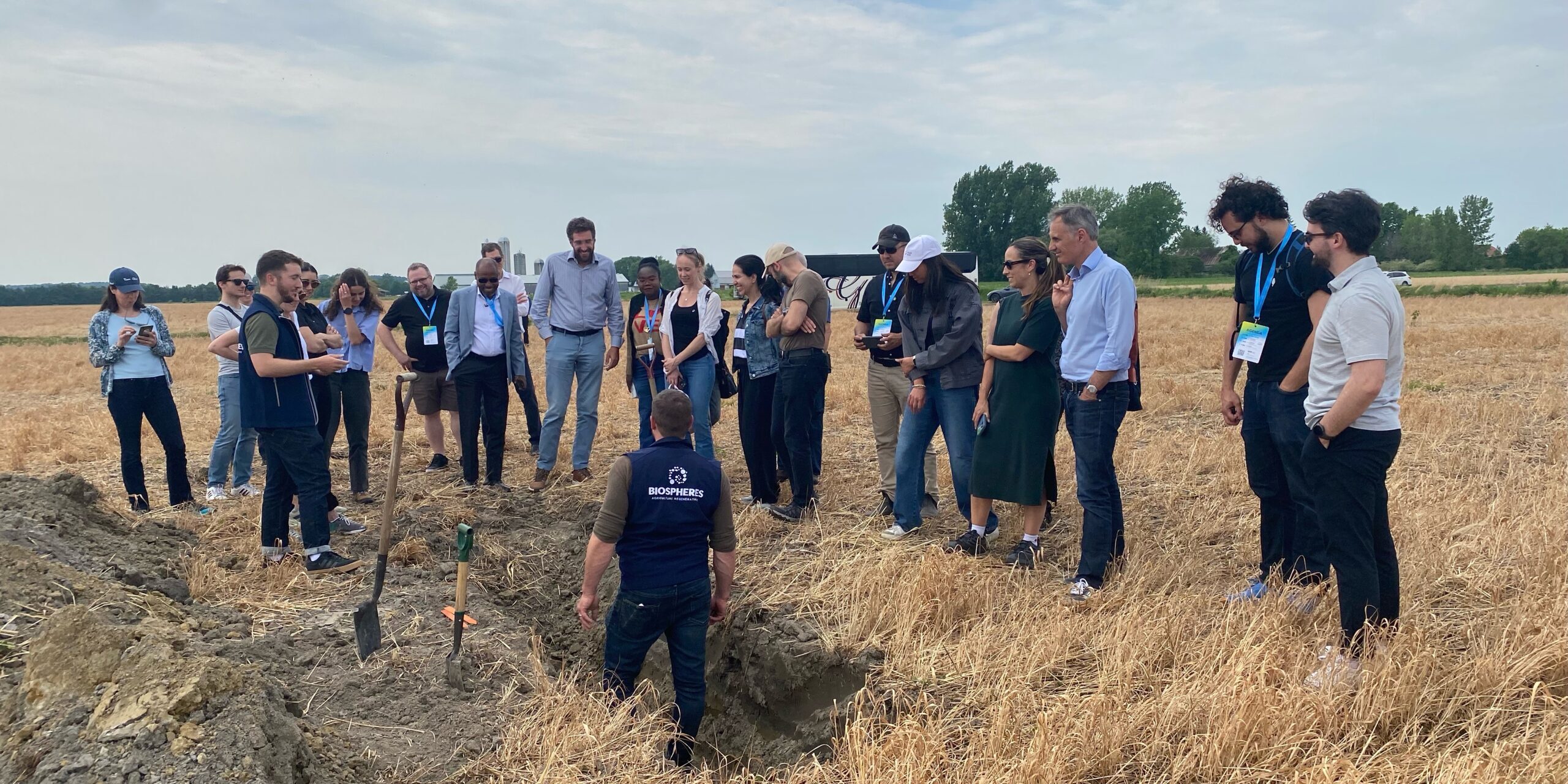
On June 5th, in Saint-Théodore-d’Acton in Montérégie, some thirty people from the financial world left the conference rooms to see what was happening under their feet, in the field.
Organized by Finance Montréal and Farm Credit Canada as part of the Sustainable Finance Summit, the event built on Finance Montréal’s work on integrating biodiversity into financial and business practices in Quebec — including the importance of better understanding sector-specific realities to inform investment and financing decisions. It included a regenerative agriculture training offered by Biospheres, represented in Quebec by agronomist Sébastien Angers, and took place at Clovis Gauthier & Sons Farm, a family business active in egg production and field crops.
On paper, this could have been a conversation about sustainable farming practices, transition, or risk management. On the ground, those words took root in soil aggregates, orange soil mottles, earthworm burrows, and cover crops.
Seeing Value Where It’s Built
Dominique Gauthier showcased a farm where agronomy and economics go hand in hand. Across roughly 900 hectares, Clovis Gauthier & Sons Farm produces a significant share of its own feed within a diversified rotation that includes identity preserved (IP) soybeans, canola, fall cereals, and cover crops.
In a region where corn dominates, the farm chose to remove it from its rotation. This allows Dominique and his family to better distribute workload, protect soils, and serve certain specialized markets.
Since 1992, the company has been committed to no-till farming. Initially, the motivation was to reduce tillage in fields where rocks complicated operations. But this decision opened the door to a different trajectory: less soil disturbance, fewer machinery passes, more active microbial life, more cover crops, and improving yields.
Land Is More Than Its Market Value
In agriculture, land is often treated as a financial asset or collateral. But its market value doesn’t tell the whole story.
Two parcels of land can look the same on a map and be worth comparable amounts. Yet one may be compacted, poor in biological life, and vulnerable to erosion, while the other has better structure, better water infiltration, and more stable organic matter.
For a lender, these differences should matter: soil health influences productivity, yield stability, climate resilience, and ultimately the long-term value of the farm operation. As Sébastien Angers puts it: “without knowing the soil, you’re lending blind.”
A transition to translate
Transitioning to regenerative practices takes time, investment, and a tolerance for uncertainty. Adapting a planter, changing a rotation, or rethinking markets involves costs, agronomic risks, and sometimes skeptical looks from neighbours.
In the case of Clovis Gauthier & Sons Farm, this evolution happened gradually, with financial partners who understood their logic and respected their pace. This is where ongoing support becomes essential: producer cohorts, when they bring together agricultural advisors, researchers, buyers, and even financial stakeholders, help share learnings and lower some of the barriers to adoption.
Producers talk about compaction, rotation, residues, organic matter, and soil structure. Financial stakeholders talk about collateral, liquidity, assets, debt, and risk. Between the two, there is still a need for interpreters and a measurement methodology translated into risk models that reflect reality.
Agricultural transition doesn’t rest solely on the willingness of producers. It also depends on institutions capable of recognizing the value of decisions made in the field.